香蔥雞翼 kakainwonderland
材料:
雞中翼(開盤)
香蔥(切段)
煲仔飯豉油 1 湯匙
.
雞翼醃料:
糖 1.5 茶匙
胡椒粉 少許
生抽 1 至 2 湯匙
老抽 半湯匙
煲仔飯豉油 1 湯匙
麻油少許
生粉 半茶匙
橄欖油 1 湯匙
.
做法:
1. 把雞翼醃好,把醃料汁留下,備用。
2. 油滾放入雞翼;
3. 放了大半雞翼之後,中火,記緊把最早落的的雞翼轉一轉,如果不是當你把所有雞翼放好之後,最初的雞翼就變得過熟了,
4. 把所有雞翼也轉過一次之後;
5. 趕快加入蔥段,平均鋪好;
6. 把之前留下的醃料汁加入半碗水和1湯匙煲仔飯豉油,再馬上加雞翼和蔥段;
7. 待再次滾起,熄火,關上蓋子焗5分鐘;
8. 5分鐘過後,開小火,滾起,便可上碟。
.
小Tips: ⭐️這個餸最重要是把握時間,時間控制得好會有嫩滑雞翼的效果,加入香蔥段,是令醬汁更加香濃,這個《香蔥雞翼》足夠可以吃三碗飯!
雞翼斬半的原因是,方便小朋友吃!這樣就會食得乾淨,而且不會擔心雞翼中不熟,因為有時候媽媽擔心雞翼中不夠熟,怕會心血水,這樣做法就不用再拍了。明天就趕快試煮吧!
Monday, June 8, 2020

Bun Cha
Vietnamese rice noodles with pork neck and meatballs (bun cha)
This Vietnamese dish is one of my favourite light meals - the combination of rice noodles, barbecued (or grilled) pork and lots of fresh vegetables and herbs leaves you feeling refreshed rather than heavy and lethargic. Most recipes for bun cha call for pork belly but I prefer pork neck (also called pork jowl). I also like to mince the meat myself, preferably in an electric grinder, but you can also use a food processor (although with this, you have to be careful you don't overprocess it int a mush) . If you don’t have either of those pieces of equipment, buy coarsely ground meat from the butcher.
In Vietnam, they tend to serve the rice noodles in a small bowl (or on a plate), the meatballs and grilled meat with the fish sauce in another bowl and the lettuce and herbs in a separate bowl or on a platter. Outside Vietnam, however, they usually pile everything in one large bowl. Serve it the way you like. Susan Jung
Ingredients
900g (31¾oz) pork neck (can use half pork neck, half coarsely minced pork)
60ml (¼ cup) cooking oil, plus extra for cooking the meat
8-10 spring onions, divided
300-400g (10½-14oz) rice vermicelli
8 garlic cloves, peeled, divided
5 red bird's-eye chillies, divided
100g (3½oz) large carrot, peeled
½ green papaya, peeled
freshly ground black pepper
lettuce leaves and fresh herbs such as coriander, mint and Thai basil
For the marinade and dipping sauce
180ml (¾ cup) fish sauce
45ml (3tbsp) fresh lime juice, or to taste
25ml (5tsp) rice vinegar
45g (3⅔tbsp) granulated sugar, or to taste
Make the marinade and dipping sauce. Mix the fish sauce with the lime juice and rice vinegar, then add the sugar and stir until it's dissolved.
Put half the pork neck into a bowl and add 80ml (¼ cup and 4tsp) of the marinade, two roughly chopped garlic cloves and two minced chillies. Mix thoroughly then refrigerate for about two hours.
Cut the remaining pork neck into small chunks and add 60ml (¼ cup) of the marinade, two sliced garlic cloves, two roughly chopped spring onions and some freshly ground pepper. Put the ingredients into a container and freeze until the meat is icy on the surface, but not frozen solid. Use a meat grinder fitted with the medium blade to coarsely grind the meat, or process briefly in a food processor until the pork is roughly chopped. Refrigerate for about two hours. (If using purchased minced meat, finely chop the garlic and spring onions, then mix them into the meat along with 60ml [¼ cup] of the marinade and some black pepper, then refrigerate.)
Make the spring onion oil. Mince the remaining spring onions. Heat the oil in a small saucepan, add the spring onion and cook until it's wilted but not brown. Set aside to cool.
Bring a large pot of water to the boil then turn off the heat. Add the rice vermicelli and let it soak in the hot water until tender but not mushy, then drain. Add some of the spring onion oil and mix it in thoroughly, adding enough to lightly coat the noodles (this flavours them and prevents them from sticking together). Reserve some of the cooked spring onion for topping the noodles before serving.
Shape the minced meat mixture into small, flat patties about 3cm (1¼ in) in diameter and cook them on a lightly oiled grill or barbecue, letting them char slightly. Cook the pork neck on the grill or barbecue and, when the meat is done, cut it across the grain into slices 5mm(¼in) thick.
Taste the remaining fish sauce mixture and add sugar and more lime juice, as necessary. Finely mince four garlic cloves and three chillies and add them to the mixture. Mix in about 60ml ( ¼ cup) of cold water, to dilute the sauce slightly; if it's still too strong, add a little more water. Pour some of the sauce over the rice noodles - just enough to moisten them - and mix thoroughly. Divide the noodles into four to eight portions and top each one with some of the cooked spring onion and a little of the spring onion oil. Cut the carrot and green papaya into thin matchsticks, add them to the remaining dipping sauce, then pour the mixture into individual bowls.
Serve the noodles with the meatballs, sliced pork neck, dipping sauce and a platter of lettuce and fresh herbs. Let each diner add the ingredients to the noodles before eating.
This Vietnamese dish is one of my favourite light meals - the combination of rice noodles, barbecued (or grilled) pork and lots of fresh vegetables and herbs leaves you feeling refreshed rather than heavy and lethargic. Most recipes for bun cha call for pork belly but I prefer pork neck (also called pork jowl). I also like to mince the meat myself, preferably in an electric grinder, but you can also use a food processor (although with this, you have to be careful you don't overprocess it int a mush) . If you don’t have either of those pieces of equipment, buy coarsely ground meat from the butcher.
In Vietnam, they tend to serve the rice noodles in a small bowl (or on a plate), the meatballs and grilled meat with the fish sauce in another bowl and the lettuce and herbs in a separate bowl or on a platter. Outside Vietnam, however, they usually pile everything in one large bowl. Serve it the way you like. Susan Jung
Ingredients
900g (31¾oz) pork neck (can use half pork neck, half coarsely minced pork)
60ml (¼ cup) cooking oil, plus extra for cooking the meat
8-10 spring onions, divided
300-400g (10½-14oz) rice vermicelli
8 garlic cloves, peeled, divided
5 red bird's-eye chillies, divided
100g (3½oz) large carrot, peeled
½ green papaya, peeled
freshly ground black pepper
lettuce leaves and fresh herbs such as coriander, mint and Thai basil
For the marinade and dipping sauce
180ml (¾ cup) fish sauce
45ml (3tbsp) fresh lime juice, or to taste
25ml (5tsp) rice vinegar
45g (3⅔tbsp) granulated sugar, or to taste
Make the marinade and dipping sauce. Mix the fish sauce with the lime juice and rice vinegar, then add the sugar and stir until it's dissolved.
Put half the pork neck into a bowl and add 80ml (¼ cup and 4tsp) of the marinade, two roughly chopped garlic cloves and two minced chillies. Mix thoroughly then refrigerate for about two hours.
Cut the remaining pork neck into small chunks and add 60ml (¼ cup) of the marinade, two sliced garlic cloves, two roughly chopped spring onions and some freshly ground pepper. Put the ingredients into a container and freeze until the meat is icy on the surface, but not frozen solid. Use a meat grinder fitted with the medium blade to coarsely grind the meat, or process briefly in a food processor until the pork is roughly chopped. Refrigerate for about two hours. (If using purchased minced meat, finely chop the garlic and spring onions, then mix them into the meat along with 60ml [¼ cup] of the marinade and some black pepper, then refrigerate.)
Make the spring onion oil. Mince the remaining spring onions. Heat the oil in a small saucepan, add the spring onion and cook until it's wilted but not brown. Set aside to cool.
Bring a large pot of water to the boil then turn off the heat. Add the rice vermicelli and let it soak in the hot water until tender but not mushy, then drain. Add some of the spring onion oil and mix it in thoroughly, adding enough to lightly coat the noodles (this flavours them and prevents them from sticking together). Reserve some of the cooked spring onion for topping the noodles before serving.
Shape the minced meat mixture into small, flat patties about 3cm (1¼ in) in diameter and cook them on a lightly oiled grill or barbecue, letting them char slightly. Cook the pork neck on the grill or barbecue and, when the meat is done, cut it across the grain into slices 5mm(¼in) thick.
Taste the remaining fish sauce mixture and add sugar and more lime juice, as necessary. Finely mince four garlic cloves and three chillies and add them to the mixture. Mix in about 60ml ( ¼ cup) of cold water, to dilute the sauce slightly; if it's still too strong, add a little more water. Pour some of the sauce over the rice noodles - just enough to moisten them - and mix thoroughly. Divide the noodles into four to eight portions and top each one with some of the cooked spring onion and a little of the spring onion oil. Cut the carrot and green papaya into thin matchsticks, add them to the remaining dipping sauce, then pour the mixture into individual bowls.
Serve the noodles with the meatballs, sliced pork neck, dipping sauce and a platter of lettuce and fresh herbs. Let each diner add the ingredients to the noodles before eating.
Easy Taiwanese fried chicken (popcorn chicken)
Taiwanese fried chicken is something you can find in night markets and small take-away shops in the country. Many times, it's a whole chicken breast that's been pounded flat so it looks enormous, then seasoned, dredged in starch and deep-fried. It's served whole, so it stays moist.
In this version, the chicken breast is cut into chunks which are fried briefly - just long enough to cook them through. Chicken breast dries out easily so it's essential that it's not overcooked.
Many recipes for Taiwanese fried chicken insist on using sweet potato flour as the coating. It gives a mild crunch but it’s not easy to find, so feel free to substitute cornstarch or plain (all-purpose) flour. Panko (Japanese bread crumbs) is not traditional, but use it for a nice crunch.
Use a pot that’s just large enough to hold five pieces of chicken at a time in one layer, with a little room to swim. If you use a larger pot, you will need more oil. Susan Jung, SCMP
Ingredients
800g (28oz) boneless, skinless chicken breast (two to four pieces, depending on size)
a chunk peeled ginger
3 large garlic cloves, peeled
2-3 spring onions
15ml (1tbsp) light soy sauce
1½tsp fine sea salt
1½tsp granulated sugar
1tsp five-spice powder
½tsp finely ground white pepper
1 large egg
starch of choice, for coating
a handful Thai basil leaves (optional)
cooking oil, for frying
For the seasoning mix
1½tsp fine sea salt
1tsp granulated sugar
¾tsp five-spice powder
¾tsp finely ground white pepper
¾tsp paprika
½-1tsp chilli flakes (I use gochugaru, Korean chilli flakes)
Cut the chicken breasts into three-bite pieces and put them in a bowl.
Use a fine grater (preferably a Japanese ceramic oroshigane) to grate the chunk of ginger until you have 15g (½ oz) of ginger purée. Put the purée into a small bowl.
Finely mince the garlic cloves and spring onions and add them to the bowl with the ginger. Mix in the soy sauce, salt, sugar, five-spice, pepper and 30ml (2tbsp) of cold water, then pour this over the chicken pieces and mix well. Leave at room temperature for one to two hours, mixing occasionally.
Mix together the ingredients for the seasoning mix.
Pour about 150g (1 cup and 2½tbsp) of your starch of choice into a wide, flat bowl (or a pie or cake pan).
Crack the egg into the bowl with the chicken and mix it in thoroughly.
Pour oil to a depth of about 5cm (2in) in a medium-size pot and place over a medium flame. Heat the oil to 170°C (340°F).
Work with five chicken pieces at a time. Place some of the chicken pieces in the bowl of starch and dredge them thoroughly. Firmly press the chicken pieces into the starch so the coating adheres and entirely covers the meat.
As soon as the pieces are coated, put them one by one in the hot oil, remembering the order in which you placed them. Let them cook for about 45 seconds, then turn them over, starting with the first that was placed in the pan. After frying them briefly, remove the chicken from the oil, again, starting with the first piece. Each piece should be fried for about 90 seconds in total (cut one open to check), or until just cooked through (larger pieces will take longer). Do not overcook. Drain the pieces on paper towels.
When it’s time to serve the chicken, reheat the oil to 180°C (350°F). If there’s not enough oil in the pan, add more.
If using Thai basil, add the leaves to the hot oil and fry for about 10 seconds. They might spatter, so be careful. Drain the fried leaves on paper towels.
Fry the chicken pieces a second time, for about 30 seconds. Remove from the oil and drain on paper towels.
As soon as the chicken pieces are refried, lightly but evenly sprinkle the seasoned salt over them, then turn them over and sprinkle the other side.
Pile the chicken and basil leaves into a dish and serve immediately, with the extra seasoned salt in a small bowl for diners to add, if they wish.
In this version, the chicken breast is cut into chunks which are fried briefly - just long enough to cook them through. Chicken breast dries out easily so it's essential that it's not overcooked.
Many recipes for Taiwanese fried chicken insist on using sweet potato flour as the coating. It gives a mild crunch but it’s not easy to find, so feel free to substitute cornstarch or plain (all-purpose) flour. Panko (Japanese bread crumbs) is not traditional, but use it for a nice crunch.
Use a pot that’s just large enough to hold five pieces of chicken at a time in one layer, with a little room to swim. If you use a larger pot, you will need more oil. Susan Jung, SCMP
Ingredients
800g (28oz) boneless, skinless chicken breast (two to four pieces, depending on size)
a chunk peeled ginger
3 large garlic cloves, peeled
2-3 spring onions
15ml (1tbsp) light soy sauce
1½tsp fine sea salt
1½tsp granulated sugar
1tsp five-spice powder
½tsp finely ground white pepper
1 large egg
starch of choice, for coating
a handful Thai basil leaves (optional)
cooking oil, for frying
For the seasoning mix
1½tsp fine sea salt
1tsp granulated sugar
¾tsp five-spice powder
¾tsp finely ground white pepper
¾tsp paprika
½-1tsp chilli flakes (I use gochugaru, Korean chilli flakes)
Cut the chicken breasts into three-bite pieces and put them in a bowl.
Use a fine grater (preferably a Japanese ceramic oroshigane) to grate the chunk of ginger until you have 15g (½ oz) of ginger purée. Put the purée into a small bowl.
Finely mince the garlic cloves and spring onions and add them to the bowl with the ginger. Mix in the soy sauce, salt, sugar, five-spice, pepper and 30ml (2tbsp) of cold water, then pour this over the chicken pieces and mix well. Leave at room temperature for one to two hours, mixing occasionally.
Mix together the ingredients for the seasoning mix.
Pour about 150g (1 cup and 2½tbsp) of your starch of choice into a wide, flat bowl (or a pie or cake pan).
Crack the egg into the bowl with the chicken and mix it in thoroughly.
Pour oil to a depth of about 5cm (2in) in a medium-size pot and place over a medium flame. Heat the oil to 170°C (340°F).
Work with five chicken pieces at a time. Place some of the chicken pieces in the bowl of starch and dredge them thoroughly. Firmly press the chicken pieces into the starch so the coating adheres and entirely covers the meat.
As soon as the pieces are coated, put them one by one in the hot oil, remembering the order in which you placed them. Let them cook for about 45 seconds, then turn them over, starting with the first that was placed in the pan. After frying them briefly, remove the chicken from the oil, again, starting with the first piece. Each piece should be fried for about 90 seconds in total (cut one open to check), or until just cooked through (larger pieces will take longer). Do not overcook. Drain the pieces on paper towels.
When it’s time to serve the chicken, reheat the oil to 180°C (350°F). If there’s not enough oil in the pan, add more.
If using Thai basil, add the leaves to the hot oil and fry for about 10 seconds. They might spatter, so be careful. Drain the fried leaves on paper towels.
Fry the chicken pieces a second time, for about 30 seconds. Remove from the oil and drain on paper towels.
As soon as the chicken pieces are refried, lightly but evenly sprinkle the seasoned salt over them, then turn them over and sprinkle the other side.
Pile the chicken and basil leaves into a dish and serve immediately, with the extra seasoned salt in a small bowl for diners to add, if they wish.
Soy sauce prawns
Susan Jung, South China Morning Post
Quick and easy, this recipe uses butter and sugar to give the prawns a rich, attractive shine. White onion is another essential ingredient, offering more sweetness than a brown onion. It is essential to use white onion in this recipe, not the more common brown-skinned onion. White onion is sweeter, especially when it is barely cooked, as it should be for this dish. The onion should be cooked just until it starts to wilt and is still a little crisp.
Soy sauce prawns is a fast and easy dish that appears on the menu of many Cantonese seafood restaurants. This version has an ingredient you wouldn’t expect in a Chinese dish: butter. It adds a gentle richness to the sauce and contributes to its attractive shine.
Chinese rock sugar comes as small, roughly shaped, pale gold lumps, which give a lovely glossy sheen to sauces. As they are hard, larger lumps take a while to dissolve, which is not a problem if you are cooking the rock sugar in a large amount of liquid, such as tong sui (hot dessert soups).
But as the two soy sauces provide the only liquid for this recipe, and will reduce too much if simmered for too long, the sugar lumps should be crushed so they will dissolve faster.
Instead of doing small amounts every time I need crushed sugar, I do a whole box (or bag) at a time. Put the sugar in a plastic bag, press out all the air and loosely seal it (if you don’t contain it somehow, the sugar will fly all over the place).
Place the bag on a heavy chopping board, cover it with a clean, dry kitchen cloth, then bash away with the flat side of a metal meat mallet (this is a good way of getting out your aggression).
The sugar will break into unevenly sized pieces; use the larger ones for tong sui and the smallest crumbs for quickly simmered dishes such as this one. If you can’t be bothered, though, use granulated white sugar.
Aged soy sauce, as its name suggests, is aged before bottling. It is not always labelled as “aged soy sauce”; the brand I buy, Yuan’s, is called royal soy sauce. It is expensive but is only used in small quantities. If you can’t find it, use dark soy sauce.
Once the ingredients are prepared, the onions and prawns take just minutes to cook.
Soy sauce prawns
12 fresh prawns, with body size about 9cm
1 white onion, about 225 grams, peeled
75ml light soy sauce
10 grams sugar, preferably finely crushed Chinese rock sugar
10ml aged soy sauce
20 grams unsalted butter, chilled
20ml cooking oil, divided
1 spring onion
Freshly ground black pepper
Lay each prawn on a cutting board, then cut off the sharp spike at the tip of the head and trim off the long antennae. Cut through the shell down the back of the prawn (I use kitchen scissors for this), making a shallow slit in the flesh, and pull out the dark vein. Dry with a paper towel.
Halve the onion, then cut it into slices about 3mm thick. Mince the spring onion.
Heat a large skillet over a high flame and, once hot, coat with 10ml of cooking oil. Add the white onion and stir constantly for about a minute (or less), until it starts to wilt. Immediately remove the onion from the skillet and spread on a serving plate.
Put the light soy sauce and crushed sugar into a small saucepan over a medium flame and stir until the sugar is dissolved. Stir in the aged soy sauce, then turn off the flame and add the butter. Swirl the pan until the butter melts and combines with the other ingredients.
Over a high flame, heat the skillet used to cook the onion (no need to wash it). When the pan is hot, coat it with 10ml of cooking oil. One by one, arrange the prawns in the hot skillet, taking care to remember which one went in first. As soon as the last prawn is placed in the skillet, start turning them over in the same order they were placed in the pan.
Once you have turned over the last prawn, pour the soy sauce-butter mixture into the skillet and bring to a boil. Turn the prawns over again, working in order from first to last. After turning over the last prawn, turn off the heat. The prawns should be lightly coated with the sauce, which will be thick and glossy. Sprinkle freshly ground black pepper over the prawns, then remove them from the skillet one at a time, starting with the first.
Arrange the prawns over the bed of onions on the serving plate. Drizzle with a little sauce from the skillet and sprinkle with the spring onion. Serve immediately.
Quick and easy, this recipe uses butter and sugar to give the prawns a rich, attractive shine. White onion is another essential ingredient, offering more sweetness than a brown onion. It is essential to use white onion in this recipe, not the more common brown-skinned onion. White onion is sweeter, especially when it is barely cooked, as it should be for this dish. The onion should be cooked just until it starts to wilt and is still a little crisp.
Soy sauce prawns is a fast and easy dish that appears on the menu of many Cantonese seafood restaurants. This version has an ingredient you wouldn’t expect in a Chinese dish: butter. It adds a gentle richness to the sauce and contributes to its attractive shine.
Chinese rock sugar comes as small, roughly shaped, pale gold lumps, which give a lovely glossy sheen to sauces. As they are hard, larger lumps take a while to dissolve, which is not a problem if you are cooking the rock sugar in a large amount of liquid, such as tong sui (hot dessert soups).
But as the two soy sauces provide the only liquid for this recipe, and will reduce too much if simmered for too long, the sugar lumps should be crushed so they will dissolve faster.
Instead of doing small amounts every time I need crushed sugar, I do a whole box (or bag) at a time. Put the sugar in a plastic bag, press out all the air and loosely seal it (if you don’t contain it somehow, the sugar will fly all over the place).
Place the bag on a heavy chopping board, cover it with a clean, dry kitchen cloth, then bash away with the flat side of a metal meat mallet (this is a good way of getting out your aggression).
The sugar will break into unevenly sized pieces; use the larger ones for tong sui and the smallest crumbs for quickly simmered dishes such as this one. If you can’t be bothered, though, use granulated white sugar.
Aged soy sauce, as its name suggests, is aged before bottling. It is not always labelled as “aged soy sauce”; the brand I buy, Yuan’s, is called royal soy sauce. It is expensive but is only used in small quantities. If you can’t find it, use dark soy sauce.
Once the ingredients are prepared, the onions and prawns take just minutes to cook.
Soy sauce prawns
12 fresh prawns, with body size about 9cm
1 white onion, about 225 grams, peeled
75ml light soy sauce
10 grams sugar, preferably finely crushed Chinese rock sugar
10ml aged soy sauce
20 grams unsalted butter, chilled
20ml cooking oil, divided
1 spring onion
Freshly ground black pepper
Lay each prawn on a cutting board, then cut off the sharp spike at the tip of the head and trim off the long antennae. Cut through the shell down the back of the prawn (I use kitchen scissors for this), making a shallow slit in the flesh, and pull out the dark vein. Dry with a paper towel.
Halve the onion, then cut it into slices about 3mm thick. Mince the spring onion.
Heat a large skillet over a high flame and, once hot, coat with 10ml of cooking oil. Add the white onion and stir constantly for about a minute (or less), until it starts to wilt. Immediately remove the onion from the skillet and spread on a serving plate.
Put the light soy sauce and crushed sugar into a small saucepan over a medium flame and stir until the sugar is dissolved. Stir in the aged soy sauce, then turn off the flame and add the butter. Swirl the pan until the butter melts and combines with the other ingredients.
Over a high flame, heat the skillet used to cook the onion (no need to wash it). When the pan is hot, coat it with 10ml of cooking oil. One by one, arrange the prawns in the hot skillet, taking care to remember which one went in first. As soon as the last prawn is placed in the skillet, start turning them over in the same order they were placed in the pan.
Once you have turned over the last prawn, pour the soy sauce-butter mixture into the skillet and bring to a boil. Turn the prawns over again, working in order from first to last. After turning over the last prawn, turn off the heat. The prawns should be lightly coated with the sauce, which will be thick and glossy. Sprinkle freshly ground black pepper over the prawns, then remove them from the skillet one at a time, starting with the first.
Arrange the prawns over the bed of onions on the serving plate. Drizzle with a little sauce from the skillet and sprinkle with the spring onion. Serve immediately.
Fried chicken wings with soy sauce
Susan Jung, This is my mother's recipe.
8-10 large chicken wings, drumette and middle joint only
Cornstarch, for dredging
Cooking oil, for frying
80ml soy sauce
40ml hot water
10 grams granulated sugar
1 garlic clove, halved
1-2 ginger slices, peeled then julienned
A few leaves of iceberg lettuce
Preheat the oven to 180 degrees Celsius. Cut the chicken wings at the joint. In a medium-sized bowl, stir together the soy sauce, water and sugar, until the sugar is dissolved. Mix in the garlic and ginger.
Pour cooking oil into a skillet to the depth of about 3cm. Place the skillet over a medium flame and heat it until the oil reaches 180 degrees. Dredge the chicken pieces in the cornstarch, shake off the excess, then fry the pieces in the oil until done, turning them over as needed so they cook evenly.
Cook the chicken in batches; do not crowd the skillet. Drain the cooked chicken on paper towels and while they are still hot dip the pieces in the soy sauce mixture, turning them over so they're evenly coated. Place the chicken on a baking tray just large enough to hold the pieces in one layer.
When all the chicken has been cooked and coated, drizzle the excess soy sauce mixture over the pieces in the baking tray. Bake at 180 degrees for about five minutes or until the soy sauce mixture has dried out slightly. Shred the lettuce leaves, place them on a serving plate and put the chicken wings on top.
8-10 large chicken wings, drumette and middle joint only
Cornstarch, for dredging
Cooking oil, for frying
80ml soy sauce
40ml hot water
10 grams granulated sugar
1 garlic clove, halved
1-2 ginger slices, peeled then julienned
A few leaves of iceberg lettuce
Preheat the oven to 180 degrees Celsius. Cut the chicken wings at the joint. In a medium-sized bowl, stir together the soy sauce, water and sugar, until the sugar is dissolved. Mix in the garlic and ginger.
Pour cooking oil into a skillet to the depth of about 3cm. Place the skillet over a medium flame and heat it until the oil reaches 180 degrees. Dredge the chicken pieces in the cornstarch, shake off the excess, then fry the pieces in the oil until done, turning them over as needed so they cook evenly.
Cook the chicken in batches; do not crowd the skillet. Drain the cooked chicken on paper towels and while they are still hot dip the pieces in the soy sauce mixture, turning them over so they're evenly coated. Place the chicken on a baking tray just large enough to hold the pieces in one layer.
When all the chicken has been cooked and coated, drizzle the excess soy sauce mixture over the pieces in the baking tray. Bake at 180 degrees for about five minutes or until the soy sauce mixture has dried out slightly. Shred the lettuce leaves, place them on a serving plate and put the chicken wings on top.
Winter melon soup
Winter melon soup is something that my Ah Mah (paternal grandmother) made frequently. As she was cooking for about 20 people at a time, her presentation was a lot simpler than the way we've photographed it. She put all the ingredients, including the winter melon (rind removed and the flesh cut into large cubes) into a pot and simmered everything together. I learned this banquet style of winter melon soup from Kwok, a friend in New York. The ingredients are the same but it looks a lot nicer.
Winter melon, despite the name, isn't a winter squash. The waxy coating on the exterior is said (by those with vivid imaginations) to look like frost - hence the name. Another reason is that the squash is considered to have a cooling effect on the body.
Of course, this delicious soup can be served at any time of the year. It's essential, though, that you use good quality, home-made stock.
To get a winter melon that will serve six to eight people, you'll probably need to order one in advance from your vegetable vendor. You'll need a wok with a high-domed lid, plus a low rack to fit into the wok.
If you can't find night-fragrant buds (also known as night jasmine or tonkin jasmine), mince a few spring onions, rinse them with cold water and scatter them over the soup just before you serve it.
1 whole winter melon, to serve six to eight people, and small enough to fit into the wok
1 litre home-made chicken stock, or as needed
4 conpoy (dried scallop), about 2.5cm in diameter
4-6 dried mushrooms, depending on size
About 20 kei ji (also known as wolfberries or goji berries)
4 thin slices (about 2cm square) Chinese ham
4-6 fresh shrimp, with bodies about 4cm long, shells and heads removed
4-6 fresh scallops, about 3cm in diameter
A small handful of night-fragrant buds
Salt, if needed
Heat the chicken stock until warm, then add the conpoy and dried mushrooms and leave to soak for about 30 minutes, or until the mushrooms are soft. Break the conpoy into shreds. Remove and discard the mushroom stems, then cut the caps into 5mm dice.
Cut off the top of the melon in a deep zig-zag pattern to expose the flesh. Scoop out the seeds and soft pulp from the cavity. Use a spoon to carefully scoop out some of the flesh to enlarge the cavity, taking care not to remove too much or the shell won't be sturdy enough and might collapse when you steam it. The shell should be about 1cm thick.
Julienne the Chinese ham against the grain and put it into the cavity of the melon. Add the mushrooms, conpoy, kei ji and the scooped-out melon flesh. Put the winter melon in a shallow, heatproof bowl. (If needed, trim off a fine shaving from the bottom of the melon so it can sit flat.)
Place the bowl containing the squash on a round rack with low feet (about 2.5cm high) in a wok. Add boiling water to the wok so it reaches the level of the rack. Heat the chicken stock until simmering then pour it into the melon until it almost reaches the top. Cover the wok with the lid and steam it over a medium-high flame until the winter melon shell is tender, adding water to the wok as needed. Don't overcook it or the squash might collapse. Cut the scallops and shrimps in half lengthwise and put them and the night-fragrant buds into the melon and steam for a few more minutes, or until the seafood is just cooked. Taste the broth and season with salt, if needed. Serve immediately. After ladling the soup and the solid ingredients into bowls, the flesh of the winter melon "tureen" can be scooped out and served.
Winter melon, despite the name, isn't a winter squash. The waxy coating on the exterior is said (by those with vivid imaginations) to look like frost - hence the name. Another reason is that the squash is considered to have a cooling effect on the body.
Of course, this delicious soup can be served at any time of the year. It's essential, though, that you use good quality, home-made stock.
To get a winter melon that will serve six to eight people, you'll probably need to order one in advance from your vegetable vendor. You'll need a wok with a high-domed lid, plus a low rack to fit into the wok.
If you can't find night-fragrant buds (also known as night jasmine or tonkin jasmine), mince a few spring onions, rinse them with cold water and scatter them over the soup just before you serve it.
1 whole winter melon, to serve six to eight people, and small enough to fit into the wok
1 litre home-made chicken stock, or as needed
4 conpoy (dried scallop), about 2.5cm in diameter
4-6 dried mushrooms, depending on size
About 20 kei ji (also known as wolfberries or goji berries)
4 thin slices (about 2cm square) Chinese ham
4-6 fresh shrimp, with bodies about 4cm long, shells and heads removed
4-6 fresh scallops, about 3cm in diameter
A small handful of night-fragrant buds
Salt, if needed
Heat the chicken stock until warm, then add the conpoy and dried mushrooms and leave to soak for about 30 minutes, or until the mushrooms are soft. Break the conpoy into shreds. Remove and discard the mushroom stems, then cut the caps into 5mm dice.
Cut off the top of the melon in a deep zig-zag pattern to expose the flesh. Scoop out the seeds and soft pulp from the cavity. Use a spoon to carefully scoop out some of the flesh to enlarge the cavity, taking care not to remove too much or the shell won't be sturdy enough and might collapse when you steam it. The shell should be about 1cm thick.
Julienne the Chinese ham against the grain and put it into the cavity of the melon. Add the mushrooms, conpoy, kei ji and the scooped-out melon flesh. Put the winter melon in a shallow, heatproof bowl. (If needed, trim off a fine shaving from the bottom of the melon so it can sit flat.)
Place the bowl containing the squash on a round rack with low feet (about 2.5cm high) in a wok. Add boiling water to the wok so it reaches the level of the rack. Heat the chicken stock until simmering then pour it into the melon until it almost reaches the top. Cover the wok with the lid and steam it over a medium-high flame until the winter melon shell is tender, adding water to the wok as needed. Don't overcook it or the squash might collapse. Cut the scallops and shrimps in half lengthwise and put them and the night-fragrant buds into the melon and steam for a few more minutes, or until the seafood is just cooked. Taste the broth and season with salt, if needed. Serve immediately. After ladling the soup and the solid ingredients into bowls, the flesh of the winter melon "tureen" can be scooped out and served.
Loh bok goh turnip cake
Loh bok goh – often called radish cake or pudding, turnip cake or pudding, or carrot cake (mostly in Singapore and Malaysia) – is available year-round, but is especially popular at the start of the lunar new year because it’s supposed to bring good fortune in the coming months. I love it freshly made and hot out of the steamer, sliced then pan-fried (which is how dim sum restaurants serve the dish) and stir-fried with XO sauce.
Loh bok goh
My mother’s technique of making this is to grate the radish, boil it in salted water, drain it (but reserve the liquid), then add rice flour and some of the liquid back to the radish, along with the stir-fried “mix-ins” (Chinese sausage, dried shrimp and dried mushrooms) before steaming it. But when I was making this with food stylist Nellie Ming Lee, she taught me her family’s method, which is easier, so that’s the technique I use now.
1 large loh bok (white radish), about 1.3kg
2-4 dried shiitake mushrooms, about 30 grams
25 grams Chinese dried shrimp
2 laap cheong (Chinese sausage)
250 grams rice flour (do not use glutinous rice flour)
20 grams fine sea salt
½ tsp finely ground white pepper
Toasted sesame seeds
Cooking oil, as needed
Put the mushrooms and shrimp in a bowl, add about 300ml of hot water, then leave at room temperature until fully hydrated. (This can take several hours, depending on the mushrooms; if you prefer, soak them in the fridge overnight.)
Trim off the top of the radish, then peel it. Grate with a large-toothed grater. You should have 1kg; if you have more or less, multiply the kg weight of the grated radish by 0.01 to determine the correct amount of salt. Put the grated radish in a bowl, add the salt and mix well. Leave at room temperature for about an hour. Drain the radish through a colander. Take handfuls of the drained radish in your hands and squeeze to remove excess moisture, then put the solids in a bowl.
Drain the hydrated mushrooms and shrimp, but reserve the soaking liquid. Squeeze the mushrooms to remove excess liquid, then cut off and discard the stems. Cut the caps into 5mm cubes. If the shrimp are large, cut them into smaller pieces. Quarter the laap cheong lengthwise, then slice into 5mm-thick pieces. Heat a wok over a medium-high flame and oil it very lightly. When the wok is hot, add the laap cheong and stir-fry until the pieces start to brown. Add the shrimp and mushrooms, stir-fry for about a minute, then set aside to cool.
Strain the mushroom and shrimp soaking liquid into a measuring cup. Add 250ml of the soaking liquid to the bowl containing the radish and salt, and mix it in. Mix in the rice flour (adjusting the amount as needed, if you had more or less grated radish) and the white pepper. Add most of the laap cheong, shrimp and mushrooms, reserving some for scattering on the top of the loh bok goh. Spray a 23cm round pan that’s at least 5cm deep with pan-coating. Stir the ingredients thoroughly before scraping into the prepared pan. Scatter with some sesame seeds and the reserved laap cheong, shrimp and mushrooms. Place over a rack in a steamer, cover with the lid and steam on high for about an hour and 15 minutes. Check the water periodically to make sure the steamer doesn’t run dry.
If pan-frying or stir-frying, leave the loh bok goh to cool to room temperature, then refrigerate until firm. For pan-frying, cut into thick slices and place them in an oiled skillet. Pan-fry until crusty on all the cut sides.
Stir-fried loh bok goh with XO sauce
Chiu Chow sweet preserved radish is called tian choi poh (or cai poh, or choi poh). It is sold whole or chopped. It looks just like regular choi poh, so if in doubt, taste – if it’s very salty, soak the vegetable in several changes of cool water, to rinse off the excess salt.
If you like, for this dish you can make the loh bok goh plain, without adding mushrooms, shrimp and Chinese sausage.
1kg loh bok goh
50 grams Chiu Chow sweet preserved radish, chopped
100 grams XO sauce, home-made or bought
1-2 red bird’s-eye chillies
40ml fish sauce
¼ tsp finely ground white pepper
200 grams bean sprouts
2-3 spring onions
Cooking oil, as needed
Cut the loh bok goh into 2cm pieces. Slice the bird’s-eye chilli into thin rounds, squeezing out and discarding as many of the seeds as possible. Cut the spring onions into 3mm-wide rounds.
Heat about 30ml of cooking oil in a well-seasoned wok placed over a high flame. When the wok is hot, add the loh boh goh. Shake the wok so that as much as possible of the loh bok goh comes into contact with the surface of the pan, so that it browns well. Use a wide cooking spatula to lift up and turn the loh bok goh, so that the surfaces of the pieces brown.
Add the Chiu Chow preserved radish, the XO sauce, bird’s-eye chillies, fish sauce and white pepper. Continue to lift and turn the ingredients. If the ingredients stick, drizzle oil into the sides of the wok.
When the loh bok goh is sizzling hot and the ingredients are well-combined, stir in the bean sprouts and mix again. Scatter with the spring onion, stir well, then transfer the ingredients to a serving plate.
Loh bok goh
My mother’s technique of making this is to grate the radish, boil it in salted water, drain it (but reserve the liquid), then add rice flour and some of the liquid back to the radish, along with the stir-fried “mix-ins” (Chinese sausage, dried shrimp and dried mushrooms) before steaming it. But when I was making this with food stylist Nellie Ming Lee, she taught me her family’s method, which is easier, so that’s the technique I use now.
1 large loh bok (white radish), about 1.3kg
2-4 dried shiitake mushrooms, about 30 grams
25 grams Chinese dried shrimp
2 laap cheong (Chinese sausage)
250 grams rice flour (do not use glutinous rice flour)
20 grams fine sea salt
½ tsp finely ground white pepper
Toasted sesame seeds
Cooking oil, as needed
Put the mushrooms and shrimp in a bowl, add about 300ml of hot water, then leave at room temperature until fully hydrated. (This can take several hours, depending on the mushrooms; if you prefer, soak them in the fridge overnight.)
Trim off the top of the radish, then peel it. Grate with a large-toothed grater. You should have 1kg; if you have more or less, multiply the kg weight of the grated radish by 0.01 to determine the correct amount of salt. Put the grated radish in a bowl, add the salt and mix well. Leave at room temperature for about an hour. Drain the radish through a colander. Take handfuls of the drained radish in your hands and squeeze to remove excess moisture, then put the solids in a bowl.
Drain the hydrated mushrooms and shrimp, but reserve the soaking liquid. Squeeze the mushrooms to remove excess liquid, then cut off and discard the stems. Cut the caps into 5mm cubes. If the shrimp are large, cut them into smaller pieces. Quarter the laap cheong lengthwise, then slice into 5mm-thick pieces. Heat a wok over a medium-high flame and oil it very lightly. When the wok is hot, add the laap cheong and stir-fry until the pieces start to brown. Add the shrimp and mushrooms, stir-fry for about a minute, then set aside to cool.
Strain the mushroom and shrimp soaking liquid into a measuring cup. Add 250ml of the soaking liquid to the bowl containing the radish and salt, and mix it in. Mix in the rice flour (adjusting the amount as needed, if you had more or less grated radish) and the white pepper. Add most of the laap cheong, shrimp and mushrooms, reserving some for scattering on the top of the loh bok goh. Spray a 23cm round pan that’s at least 5cm deep with pan-coating. Stir the ingredients thoroughly before scraping into the prepared pan. Scatter with some sesame seeds and the reserved laap cheong, shrimp and mushrooms. Place over a rack in a steamer, cover with the lid and steam on high for about an hour and 15 minutes. Check the water periodically to make sure the steamer doesn’t run dry.
If pan-frying or stir-frying, leave the loh bok goh to cool to room temperature, then refrigerate until firm. For pan-frying, cut into thick slices and place them in an oiled skillet. Pan-fry until crusty on all the cut sides.
Stir-fried loh bok goh with XO sauce
Chiu Chow sweet preserved radish is called tian choi poh (or cai poh, or choi poh). It is sold whole or chopped. It looks just like regular choi poh, so if in doubt, taste – if it’s very salty, soak the vegetable in several changes of cool water, to rinse off the excess salt.
If you like, for this dish you can make the loh bok goh plain, without adding mushrooms, shrimp and Chinese sausage.
1kg loh bok goh
50 grams Chiu Chow sweet preserved radish, chopped
100 grams XO sauce, home-made or bought
1-2 red bird’s-eye chillies
40ml fish sauce
¼ tsp finely ground white pepper
200 grams bean sprouts
2-3 spring onions
Cooking oil, as needed
Cut the loh bok goh into 2cm pieces. Slice the bird’s-eye chilli into thin rounds, squeezing out and discarding as many of the seeds as possible. Cut the spring onions into 3mm-wide rounds.
Heat about 30ml of cooking oil in a well-seasoned wok placed over a high flame. When the wok is hot, add the loh boh goh. Shake the wok so that as much as possible of the loh bok goh comes into contact with the surface of the pan, so that it browns well. Use a wide cooking spatula to lift up and turn the loh bok goh, so that the surfaces of the pieces brown.
Add the Chiu Chow preserved radish, the XO sauce, bird’s-eye chillies, fish sauce and white pepper. Continue to lift and turn the ingredients. If the ingredients stick, drizzle oil into the sides of the wok.
When the loh bok goh is sizzling hot and the ingredients are well-combined, stir in the bean sprouts and mix again. Scatter with the spring onion, stir well, then transfer the ingredients to a serving plate.
Chinese chicken curry
https://www.scmp.com/magazines/post-magazine/food-drink/article/3025487/how-make-chinese-chicken-curry-family-recipe
This is comfort food. When I was growing up in the United States, it’s a dish my paternal grandmother made often for her Saturday dinners or Sunday lunches for the family. And, when I left home, it was a familiar dish to order at inexpensive “rice plate” Chinese restaurants. It’s something I make at home, too, although my recipe is slightly different from my grandmother’s: she didn’t use fish sauce but I do, and I prefer to add coconut milk instead of the canned evaporated milk she used. But it still tastes of home. Susan Jung
Curry powders vary a lot in flavour, depending on the spices used. I use the Koon Yick Wah Kee brand, which is made in Hong Kong. If you like a slightly spicy curry, and there’s not enough chilli in your brand of curry powder (you should taste it, first), add a small amount of cayenne pepper or Korean chilli flakes (gochugaru). It shouldn’t be very spicy though – the flavour should be mild and slightly sweet.
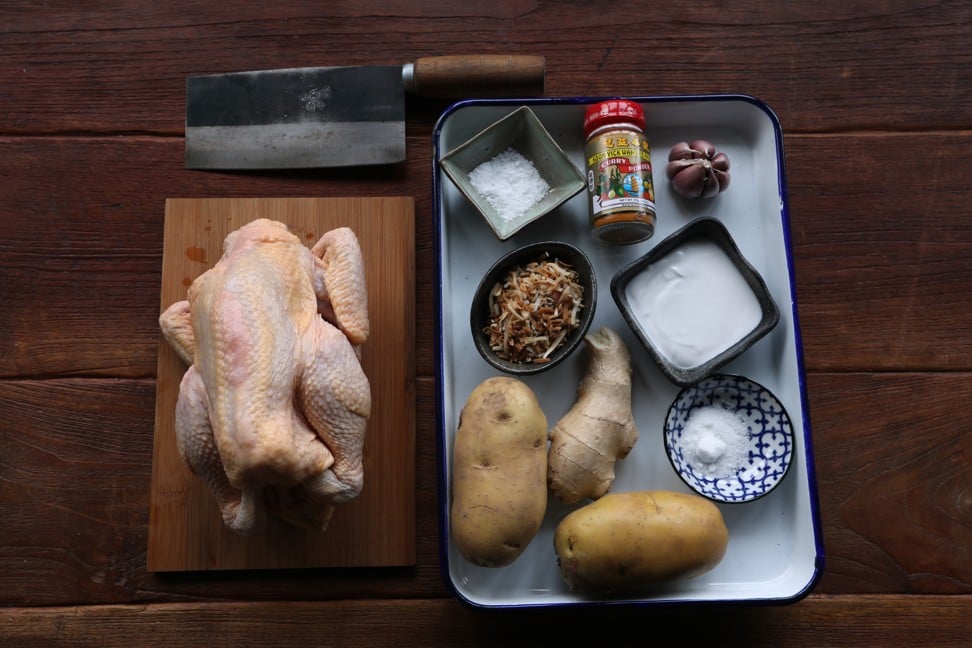
1 fresh chicken, about 1.2kg (42 1/3 oz)
Cornstarch, as needed
Cooking oil, as needed
1 onion, about 250 grams (9 oz)
1-2 garlic cloves
1-2 tsp grated ginger
2-3 tsp curry powder
1/8 tsp cayenne pepper or Korean chilli flakes (optional)
15ml fish sauce
350 grams all-purpose potatoes
Fine sea salt
5 grams granulated sugar
200ml coconut milk
Toasted coconut shreds
Cut the chicken into nine pieces: two drumsticks, two thighs, two wings (middle and drumette joints only), two breasts and the lower back. (The upper back, neck, wing tips, feet and carcass bones can be simmered to make chicken broth for another dish.)
Pour oil into a large skillet to the depth of about 2cm (7/8 inch) and place over a medium flame. Spoon some cornstarch into a shallow dish. Dredge the chicken pieces in the cornstarch to coat them completely, then shake off the excess. When the oil is 180 degrees (350 degrees Fahrenheit) Celsius, place the chicken pieces in the pan and cook until the crust is set – you don’t want to cook the meat completely.
Turn the pieces over and fry the other side. You’ll probably need to do this in batches; don’t crowd the pan. When the chicken pieces are ready, drain them on paper towels.
Finely chop the onion and mince the garlic. Peel the potatoes and cut them into 2cm (7/8 inch) chunks.
Heat about 30ml (2 tbsp) of oil in a wide pot and place it over a medium flame. When the oil is hot, add the onion and garlic and cook, stirring often, until the onion is translucent but not brown; if necessary, lower the heat.
Add the ginger and stir for about 30 seconds, then mix in the curry powder (and the cayenne or chilli flakes, if using). Stir almost constantly for about 30 seconds, then pour in the fish sauce, five grams (1 tsp) of sugar and 400ml (1 2/3 cup) of water. Add the potatoes and bring the liquid to a boil. Lower the heat, cover with the lid and simmer for about 10 minutes.
Add the dark meat chicken pieces to the pot – drumsticks, thighs and lower back – nestling them among the potatoes so they are partially submerged in the liquid. Bring to the boil then lower the flame, cover the pot with the lid and simmer for eight minutes, stirring occasionally and turning over the pieces halfway through.
Add the wings and breast pieces, mix well, then simmer for five minutes.
Add almost all the coconut milk, reserving about 15ml (1 tbsp), then stir the ingredients. Simmer for a few minutes, then taste the sauce. If it’s too spicy, add a little more sugar. If the sauce is too thick, stir in some water.
Ladle the ingredients into a serving bowl and drizzle with the reserved coconut milk. Scatter the toasted coconut shreds on top and serve immediately, with plenty of rice to sop up the sauce. Serves four to six as part of a Chinese meal.
Sunday, June 7, 2020
Cambodian Pork stick for BBQ
From Chantha, Youtube
2 to 3 lbs Pork meat/ pork belly
2 tablespoon Salt
2 tablespoon Sugar
10 garlic cloves
Fish sauce
Black pepper
Oyster sauce
Sweet soy sauce
Thick soy sauce
2 to 3 lbs Pork meat/ pork belly
2 tablespoon Salt
2 tablespoon Sugar
10 garlic cloves
Fish sauce
Black pepper
Oyster sauce
Sweet soy sauce
Thick soy sauce
Cambodian Lemongrass beef
From Chantha, Youtube
Lemongrass beef stick for BBQ
5 lb beef, cubed
3 stalks lemongrass, chopped
6 garlic cloves, chopped
kaffir lime leaves
5 red Thai chill pepper
1 teaspoon turmeric powder
1 teaspoon Galanga powder, or use fresh
Salt
2 tablespoon oil
1 tablespoon Mudfish - creamy or liquid
3 tablespoon sugar
2 teaspoon fish sauce
Spice paste: Pound the following spice in mortar or use food processor
3 stalks lemongrass
6 garlic cloves
kaffir lime leaves
5 red Thai chill pepper
1 teaspoon turmeric powder
1 teaspoon Galanga powder
Salt
Add spice paste to the beef. Then add fish sauce, mudfish, sugar, and oil to beef. Cook a piece of beef in the microware or pan for 30 seconds. Adjust and correct taste. Beef is best marinated overnight.
For beef sticks, soak bamboo sticks in water for a couple hours.
When assembling the beef sticks, make sure to cover all the bamboo sticks, don't leave any sticks exposed to fire or it will burn.
Beef sticks is best marinated over night.
*Another Recipe for reference*
Cambodian Lemongrass Beef Skewers by Jannie Lam, Youtube
Lemongrass grass beef skewers aka Sach-Go Jahgak ingredients and measurement list:
2.5-3lbs of skirt steak or flap meat
1/2 cup of kreung packed (blend of lemongrass, garlic, kefir lime leaves, and turmeric)
1 tablespoon chicken powder
1/4 cup oyster sauce
1/3 cup chili paste
1/2 teaspoon kosher salt
1 tablespoon honey
Lemongrass beef stick for BBQ
5 lb beef, cubed
3 stalks lemongrass, chopped
6 garlic cloves, chopped
kaffir lime leaves
5 red Thai chill pepper
1 teaspoon turmeric powder
1 teaspoon Galanga powder, or use fresh
Salt
2 tablespoon oil
1 tablespoon Mudfish - creamy or liquid
3 tablespoon sugar
2 teaspoon fish sauce
Spice paste: Pound the following spice in mortar or use food processor
3 stalks lemongrass
6 garlic cloves
kaffir lime leaves
5 red Thai chill pepper
1 teaspoon turmeric powder
1 teaspoon Galanga powder
Salt
Add spice paste to the beef. Then add fish sauce, mudfish, sugar, and oil to beef. Cook a piece of beef in the microware or pan for 30 seconds. Adjust and correct taste. Beef is best marinated overnight.
For beef sticks, soak bamboo sticks in water for a couple hours.
When assembling the beef sticks, make sure to cover all the bamboo sticks, don't leave any sticks exposed to fire or it will burn.
Beef sticks is best marinated over night.
*Another Recipe for reference*
Cambodian Lemongrass Beef Skewers by Jannie Lam, Youtube
Lemongrass grass beef skewers aka Sach-Go Jahgak ingredients and measurement list:
2.5-3lbs of skirt steak or flap meat
1/2 cup of kreung packed (blend of lemongrass, garlic, kefir lime leaves, and turmeric)
1 tablespoon chicken powder
1/4 cup oyster sauce
1/3 cup chili paste
1/2 teaspoon kosher salt
1 tablespoon honey
Seafood Ettoufe
Seafood Étouffée by Insatiably Epicurious
Étouffée by definition is “to smother”. And smother it does. It is designed to completely envelop you in a blanket of soothing gravy and rice. Then just as you settle into the warm comforting textures, a kaleidoscope of flavors pulls you in even further. The holy trinity of onions, peppers, and celery provides an aromatic base. Shrimp and scallops lend a nice heartiness, while oysters add a briny note to the dish. Served atop steamed rice with a side of red beans, and you have a wonderfully comforting weekend dinner.
Ingredients:
10oz jar small or medium oysters- drained
½ lb shrimp- peeled and deveined
3 large scallops- sliced in half horizontally
2 cups onions- chopped
1 cup celery- chopped
½ cup green bell peppers- chopped
2 tbsp parsley- finely chopped
3 tbsp scallions-chopped
2 tsp minced garlic
2 bay leaves
½ stick unsalted butter
¾ cup white wine
¼ cup flour
2 cups clam juice
salt (taste as you go)
*chili pepper flakes (optional)
Directions:
Slice scallops in half horizontally. Rinse and drain oysters.
In a large sauté pan over low heat, melt the butter and stir in flour. Keep stirring for about 10min or until roux becomes a light caramel color.
Add the onions, celery, and bell peppers. Sauté until the vegetables are wilted.
Add clam juice, white wine, garlic, bay leaves, parsley, scallions, and cayenne. Increase the heat to low medium. Simmer for about 5-8min.
Add oysters, scallops, shrimp. Cook for 3-5min, stirring occasionally.
Taste and season with salt and cayenne. Adjust if necessary.
Serve over steamed rice. Garnish with more chopped scallions if desired.
Étouffée by definition is “to smother”. And smother it does. It is designed to completely envelop you in a blanket of soothing gravy and rice. Then just as you settle into the warm comforting textures, a kaleidoscope of flavors pulls you in even further. The holy trinity of onions, peppers, and celery provides an aromatic base. Shrimp and scallops lend a nice heartiness, while oysters add a briny note to the dish. Served atop steamed rice with a side of red beans, and you have a wonderfully comforting weekend dinner.
Ingredients:
10oz jar small or medium oysters- drained
½ lb shrimp- peeled and deveined
3 large scallops- sliced in half horizontally
2 cups onions- chopped
1 cup celery- chopped
½ cup green bell peppers- chopped
2 tbsp parsley- finely chopped
3 tbsp scallions-chopped
2 tsp minced garlic
2 bay leaves
½ stick unsalted butter
¾ cup white wine
¼ cup flour
2 cups clam juice
salt (taste as you go)
*chili pepper flakes (optional)
Directions:
Slice scallops in half horizontally. Rinse and drain oysters.
In a large sauté pan over low heat, melt the butter and stir in flour. Keep stirring for about 10min or until roux becomes a light caramel color.
Add the onions, celery, and bell peppers. Sauté until the vegetables are wilted.
Add clam juice, white wine, garlic, bay leaves, parsley, scallions, and cayenne. Increase the heat to low medium. Simmer for about 5-8min.
Add oysters, scallops, shrimp. Cook for 3-5min, stirring occasionally.
Taste and season with salt and cayenne. Adjust if necessary.
Serve over steamed rice. Garnish with more chopped scallions if desired.
Subscribe to:
Posts (Atom)
Miso Eggplant Salad With Chickpeas
Miso Eggplant Salad With Chickpeas The flawless flavor pairing found in the popular Japanese dish miso-glazed eggplant serves as inspiration...

-
Dan Dan Noodle Salad - Hetty Lui McKinnon Turns out, dan dan noodles work well as a salad, in this recipe adapted from my cookbook “Linger: ...
-
Masala Chickpeas With Tofu and Blistered Tomatoes Like a warm and gentle nudge, masala spice gives onions and chickpeas a distinctively comf...

